Pulleys
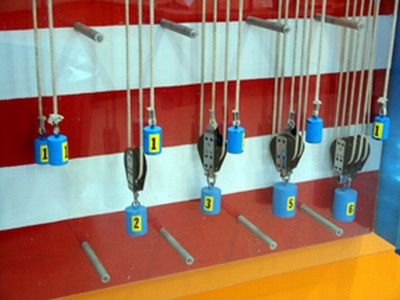
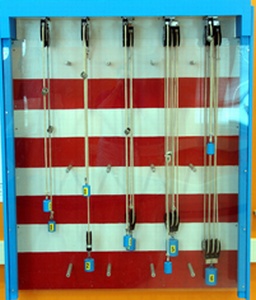
Pulleys are mechanisms composed of wheels and ropes used to lift heavy objects. They change the direction of an applied force and they can even reduce the force needed to lift a weight. Pulley systems are commonly used in construction.
In the exhibit, systems of one to five pulleys are uses to lift a weight of 1lb onto a 1 ft height.
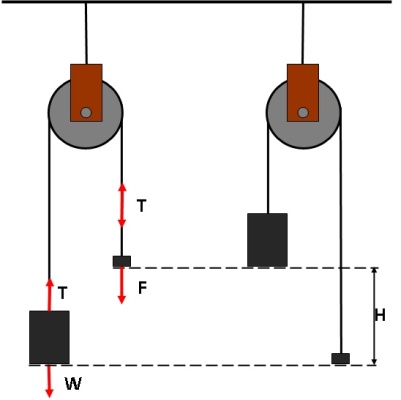
A SIMPLE BLOCK AND TACKLE
In order to lift the 1lb weight W you have to apply a force of F on the rope equal to the weight W. The rope is now under a tension T equal to the force F.
To lift this weight a distance of H=1 ft you will have to pull in a length L= H=1 ft of the rope.
The mechanical advantage M is one: M=W/F=1.
ADDING A PULLEY
In order to lift the 1lb weight W you have to apply a force of F on the rope. Like in the simple case of the block and tackle the rope is under a tension T equal to the applied force F. But in this case the weight is supported by twice the tension: 2T=W. The force F you have to apply then is only half of the weight W.
By having the second pulley you have decreased the force needed to lift the weight. The mechanical advantage M is now two: M=W/F=2T/T=2.
However, order to lift the weight a distance of H=1 ft you will have to pull in a length L = H x M =2 ft of the rope.
You gained by having to apply a smaller force, but had to compensate by having to pull a longer length of rope.
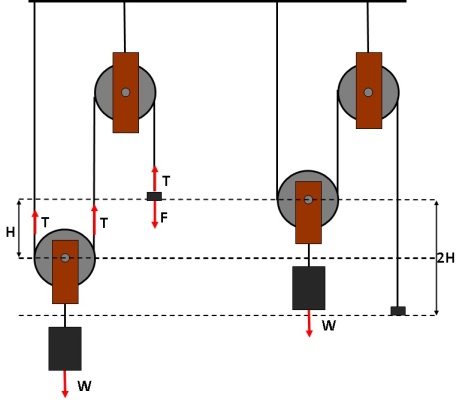
MORE PULLEYS
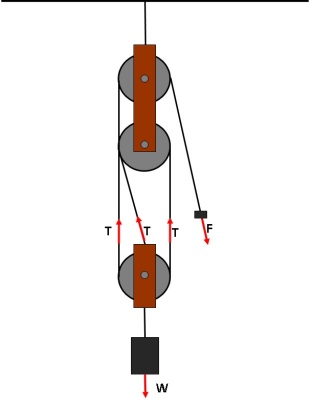
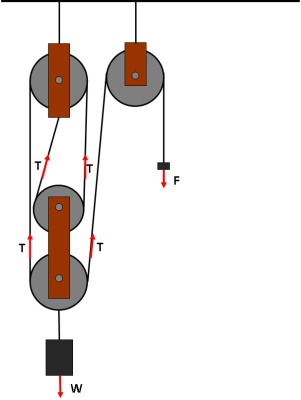
Conclusion
The mechanical advantage M is equal to number of ropes present at the weight end. The force needed to raise the weight is W/M. In order to lift the weight a distance H you will have to pull a corresponding longer length of rope L = H x M.