IceCube analysis indicates there are many high-energy astrophysical neutrino sources
This story was originally published by WIPACBack in 2013, the IceCube Neutrino Observatory—a cubic-kilometer neutrino detector embedded in Antarctic ice—announced the first observation of high-energy (above 100 TeV) neutrinos originating from outside our solar system, spawning a new age in astronomy. Four years later, on September 22, 2017, a high-energy neutrino event was detected coincident with a gamma-ray flare from a cosmic particle accelerator, a blazar known as TXS 0506+056. The coincident observation provided the first evidence for an extragalactic source of high-energy neutrinos. The identification of this source was possible thanks to IceCube’s real-time high-energy neutrino alert program, which notifies the community of directions and energies of individual neutrinos that are most likely to have come from astrophysical sources. These alerts trigger follow-up observations of electromagnetic waves from radio up to gamma-ray, aimed at pinpointing a possible astrophysical source of high-energy neutrinos. However, the sources of the vast majority of the measured diffuse flux of astrophysical neutrinos still remain a mystery, as do how many of those sources exist. Another mystery is whether the neutrino sources are steady or variable over time and, if variable, whether they vary over long or short time scales. In a paper recently submitted to The Astrophysical Journal, the IceCube Collaboration presents a follow-up search that looked for additional, lower-energy events in the direction of the high-energy alert events. The analysis looked at low- and high-energy events from 2011-2020 and was conducted to search for the coincidence in different time scales from 1,000 seconds up to one decade. Although the researchers did not find an excess of low-energy events across the searched time scales, they were able to constrain the abundance of astrophysical neutrino sources in the universe.
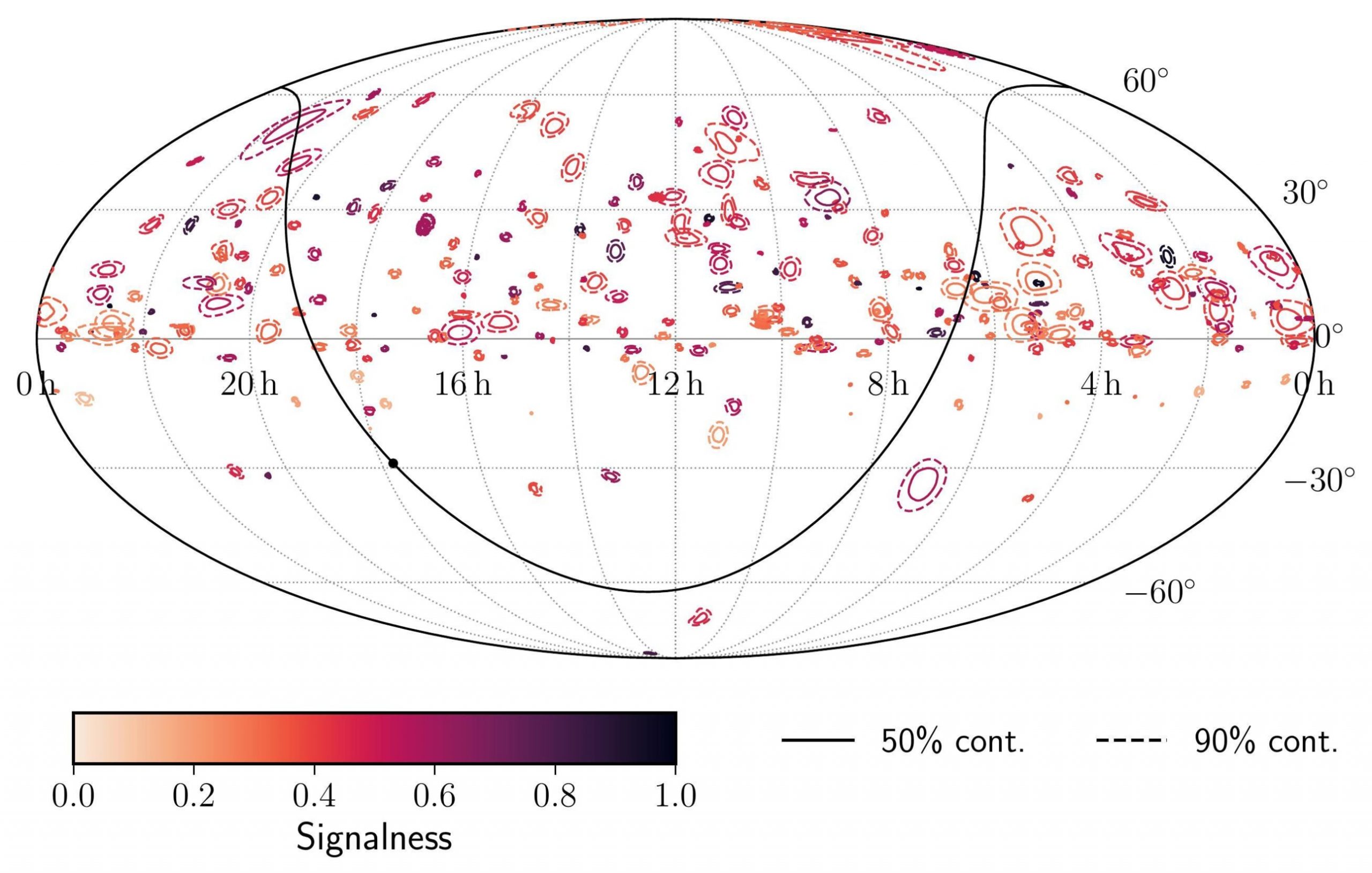
Map of high-energy neutrino candidates (“alert events”) detected by IceCube. The map is in celestial coordinates, with the Galactic plane indicated by a line and the Galactic center by a dot. Two contours are shown for each event, for 50% and 90% confidence in the localization on the sky. The color scale shows the “signalness” of each event, which quantifies the likelihood that each event is an astrophysical neutrino rather than a background event from Earth’s atmosphere. Credit: IceCube Collaboration
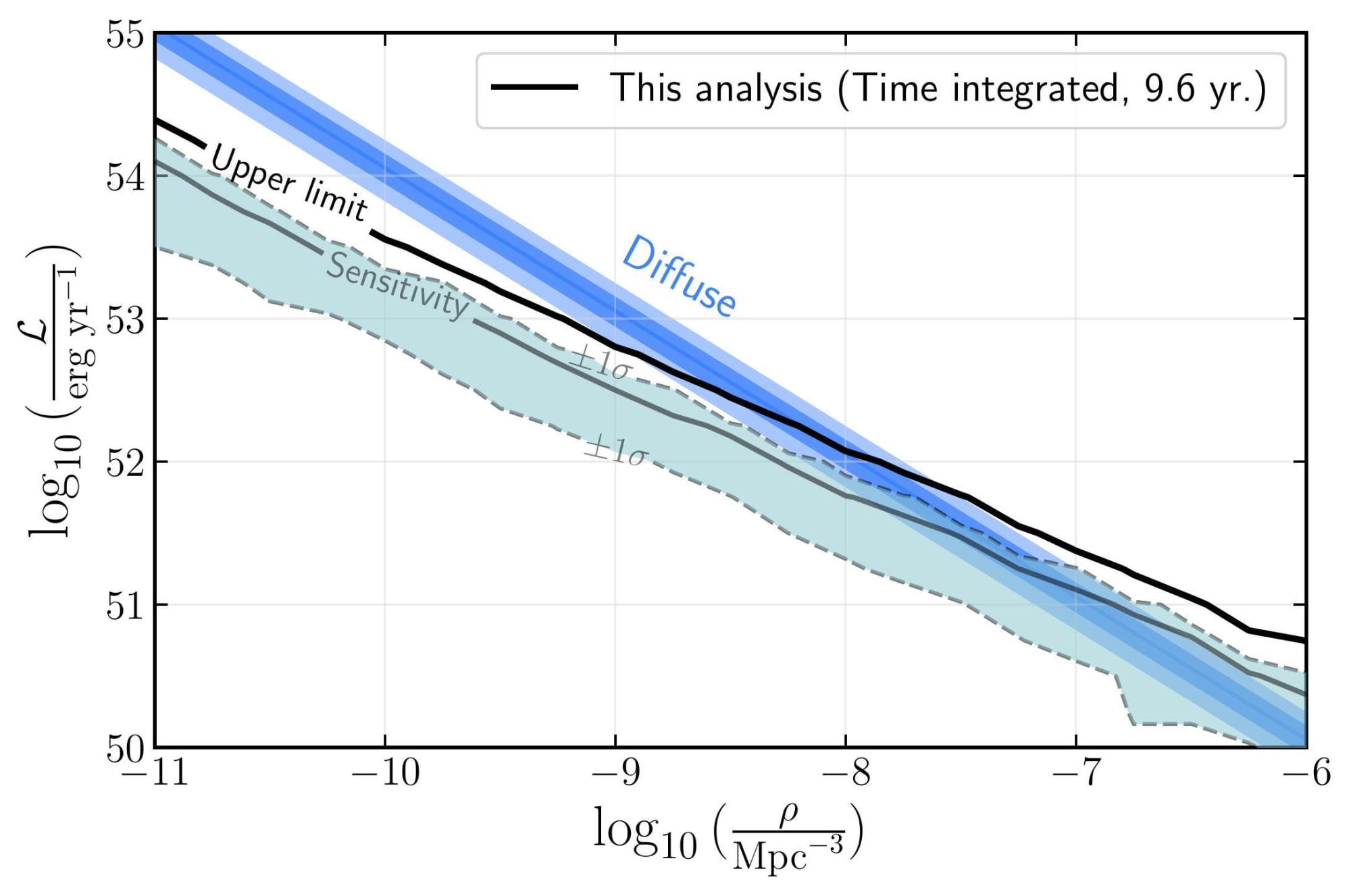
Constraints on the luminosity (power) of each individual source as a function of the number density of astrophysical neutrino sources (horizontal axis). Previous IceCube measurements of the total astrophysical neutrino flux indicate that the true combination of the two quantities must lie within the diagonal band marked “diffuse.” The results of the new analysis are shown as an upper limit, compared to the sensitivity, which shows the range of results expected from background alone (no additional signal neutrinos associated with the directions of alert events). The upper limit is above the sensitivity because there is a statistical excess in the result (p = 0.018). Credit: IceCube Collaboration