Events at Physics |
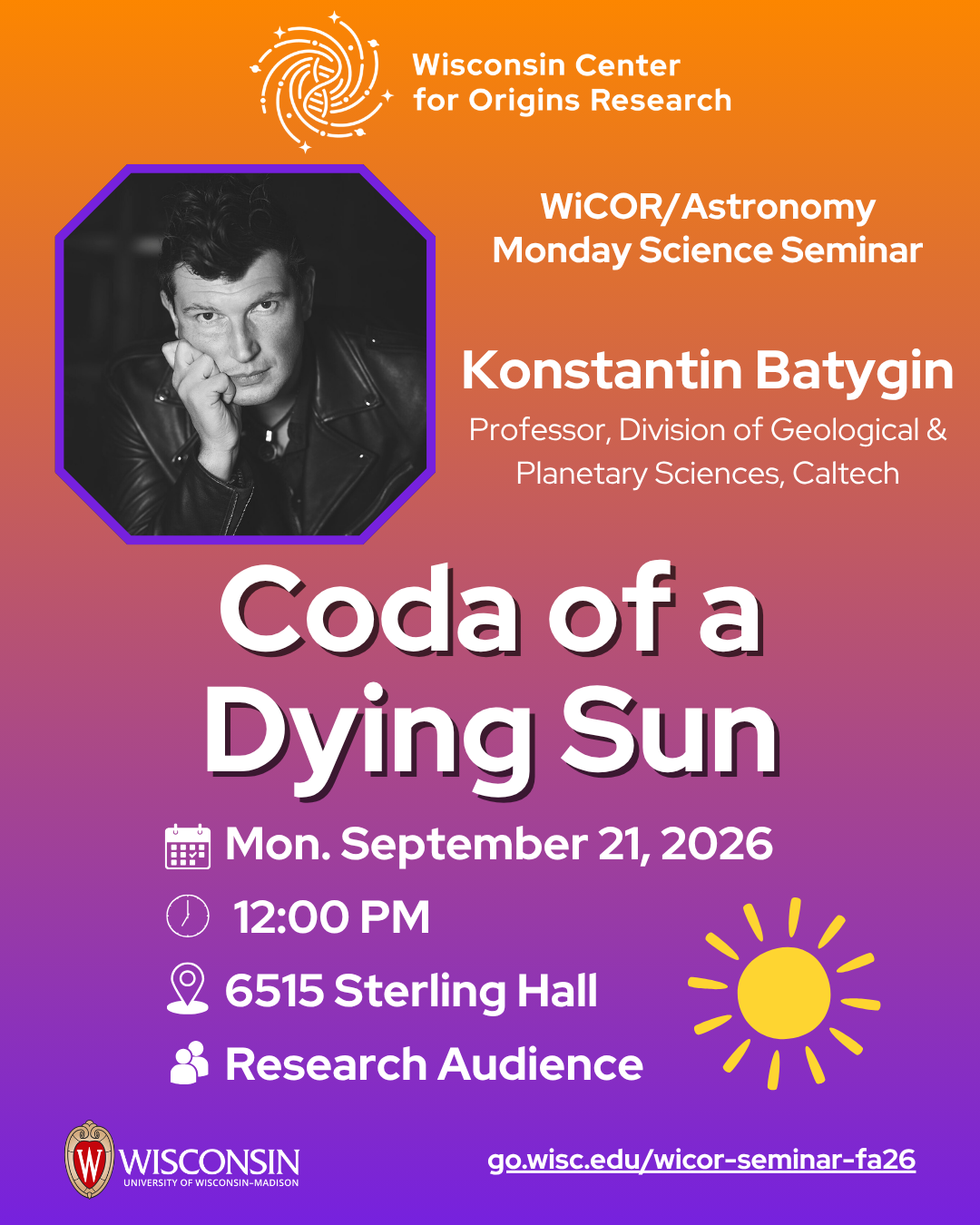
Here, we show that these estimates rest on the assumption that solar mass loss is smooth. The recently measured recoil of white dwarfs instead points to asymmetric mass loss, most readily attributed to discrete, independently directed ejections that impulsively perturb stellar motion. As the Sun sheds its envelope in such parcels, the planetary orbits undergo a random walk whose amplitude is determined by the granularity of the mass loss. For granularity consistent with observationally permitted kicks, this stochastic forcing restructures the outer Solar System concurrently with the Sun’s death.
Our numerical experiments reveal that orbit crossing can begin on the red giant branch, with roughly 40 percent of realizations undergoing disruption or violent scattering before the white dwarf forms and roughly 90 percent self-destructing within 3 billion years. The dynamical lifetime of the outer Solar System thus collapses from approximately 10^18 years to about a billion years after white dwarf formation.