New technique reveals changing shapes of magnetic noise in space and time
This article was originally published by Princeton EngineeringElectromagnetic noise poses a major problem for communications, prompting wireless carriers to invest heavily in technologies to overcome it. But for a team of scientists exploring the atomic realm, measuring tiny fluctuations in noise could hold the key to discovery. “Noise is usually thought of as a nuisance, but physicists can learn many things by studying noise,” said Nathalie de Leon, an associate professor of electrical and computer engineering at Princeton University. “By measuring the noise in a material, they can learn its composition, its temperature, how electrons flow and interact with one another, and how spins order to form magnets. It is generally difficult to measure anything about how the noise changes in space or time.” Using specially designed diamonds, a team of researchers at Princeton and the University of Wisconsin–Madison have developed a technique to measure noise in a material by studying correlations, and they can use this information to learn the spatial structure and time-varying nature of the noise. This technique, which relies on tracking tiny fluctuations in magnetic fields, represents a stark improvement over previous methods that averaged many separate measurements.
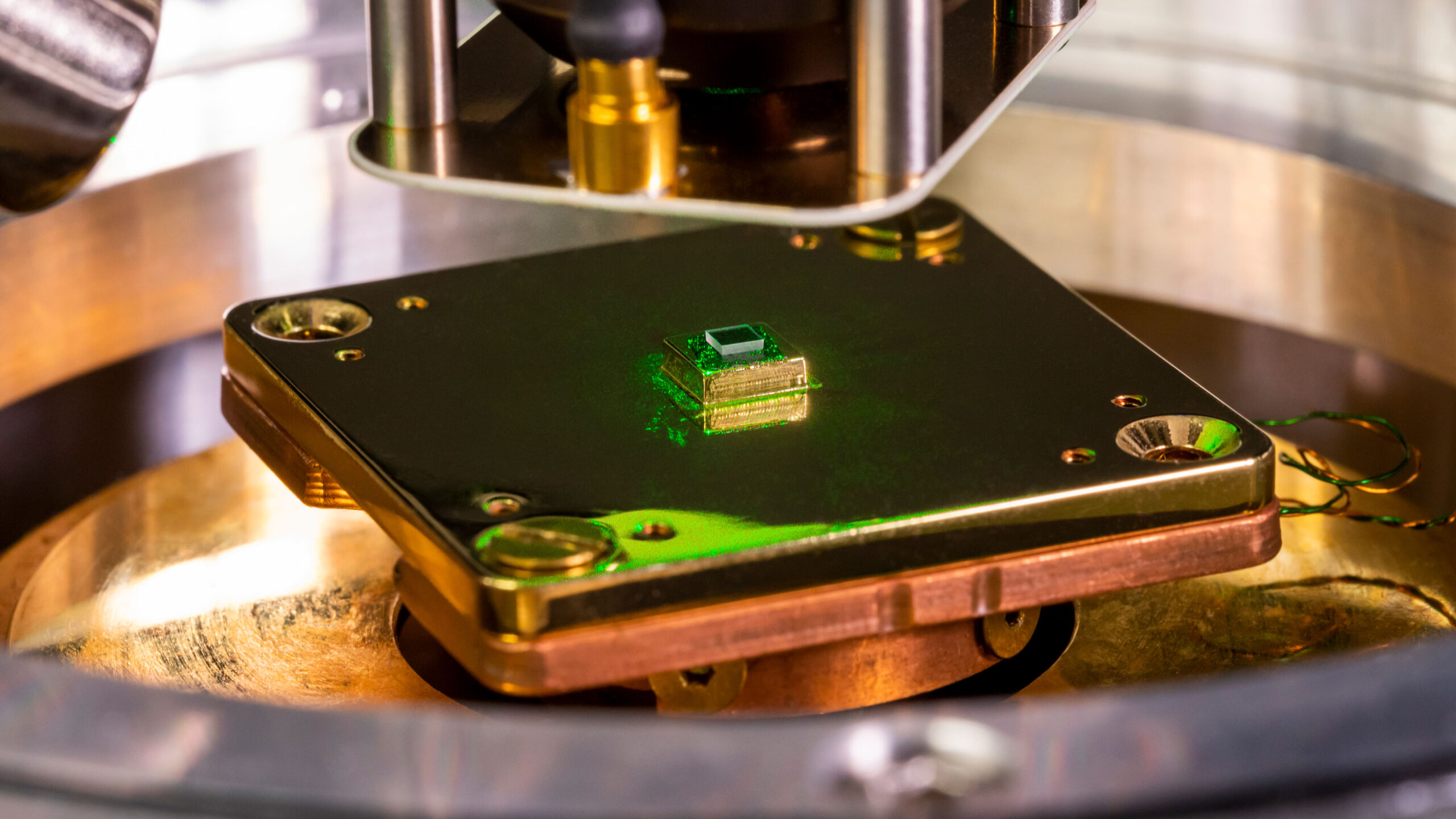
Using specially designed diamonds with nitrogen-vacancy centers, researchers at Princeton University and the University of Wisconsin–Madison have developed a technique to measure noise in a material by studying correlations, and they can use this information to learn the spatial structure and time-varying nature of the noise. In this image, a diamond with near-surface nitrogen-vacancy centers is illuminated by green laser light from a microscope objective lens | Photo by David Kelly Crow and provided by Princeton University

Shimon Kolkowitz
“One of those two spikes is a signal we’re applying, the other is a spike from the local environment, and there’s no way to tell the difference,” said study coauthor Shimon Kolkowitz, an associate professor of physics at the University of Wisconsin–Madison. “But when we look at the correlations, the one that is correlated is from the signal we’re applying and the other is not. And we can measure that, which is something people couldn’t measure before.”Kolkowitz and de Leon met as Ph.D. students at Harvard University, and have been in touch frequently since then. Their research collaboration arose early in the COVID-19 pandemic, when laboratory research slowed, but long-distance collaboration became more attractive as most interactions took place over Zoom, said de Leon. Jared Rovny, the study’s lead author and a postdoctoral research associate in de Leon’s group, led both the theoretical and experimental work on the new method. Contributions by Kolkowitz and his team were critical to designing the experiments and understanding the data, said de Leon. The paper’s coauthors also included Ahmed Abdalla and Laura Futamura, who conducted summer research with de Leon’s team in 2021 and 2022, respectively, as interns in the Quantum Undergraduate Research at IBM and Princeton (QURIP) program, which de Leon cofounded in 2019. The article, Nanoscale covariance magnetometry with diamond quantum sensors, was published online Dec. 22 in Science. Other coauthors were Zhiyang Yuan, a Ph.D. student at Princeton; Mattias Fitzpatrick, who earned a Ph.D. at Princeton in 2019 and was a postdoctoral research fellow in de Leon’s group (now an assistant professor at Dartmouth’s Thayer School of Engineering); and Carter Fox and Matthew Carl Cambria of the University of Wisconsin–Madison. Support for the research was provided in part by the U.S. National Science Foundation, the U.S. Department of Energy, the Princeton Catalysis Initiative and the Princeton Quantum Initiative. The University of Wisconsin–Madison’s Department of Physics contributed to this article.